"Pocahontas" at the National Portrait Gallery, 10-6-24
Alright, let's begin.
For my first post in this new, reimagined version of Not in the History Books, I want to share a portrait that I think about often and had the pleasure of seeing in person at the National Portrait Gallery in Washington D.C. in 2024.
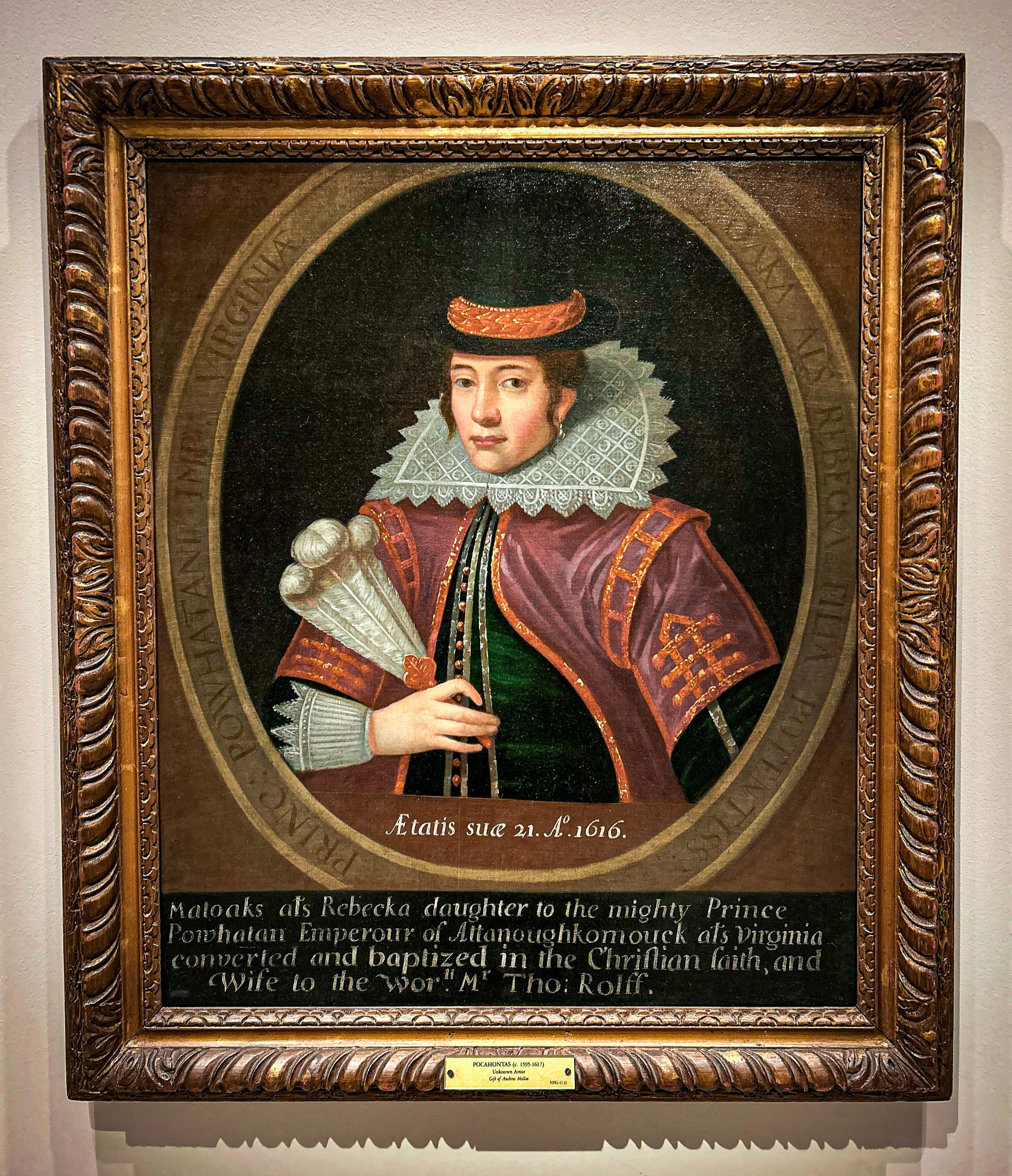
"Pocahontas", painted by an unknown artist, depicts the Powhatan woman known for her association with the Jamestown settlement, the first permanent English settlement in North America. The exhibition label goes more in depth about this particular painting and her history:
Born near present-day Richmond, Virginia, Matoaka, also known as Pocahontas, grew up in coastal Virginia among a confederacy of Algonquian-speaking Powhatan people overseen by her father. After John Smith and other representatives of the Virginia Company of London established a settlement at Jamestown, she promoted their peaceful relations with her people. Yet in 1613, an English sea captain kidnapped and ransomed her for corn, guns, and prisoners. While in captivity, Pocahontas was converted to Christianity, took the name Rebecca, and married the tobacco farmer John Rolfe. Their son, Thomas, was born in 1615. Eager to publicize Pocahontas’s apparent assimilation as a means of attracting investors, the Virginia Company transported her to England, where she arrived in June 1616. This painting, based on an engraving from that time, depicts Pocahontas as an affluent Englishwoman. Inscriptions proclaim her elite lineage, Christian religion, and marital status (confusing her son’s name with her husband’s). Pocahontas took ill and died nine months after arriving in England. Over the next four hundred years, her brief life inspired tributes and legends, including a fictitious romance with John Smith.
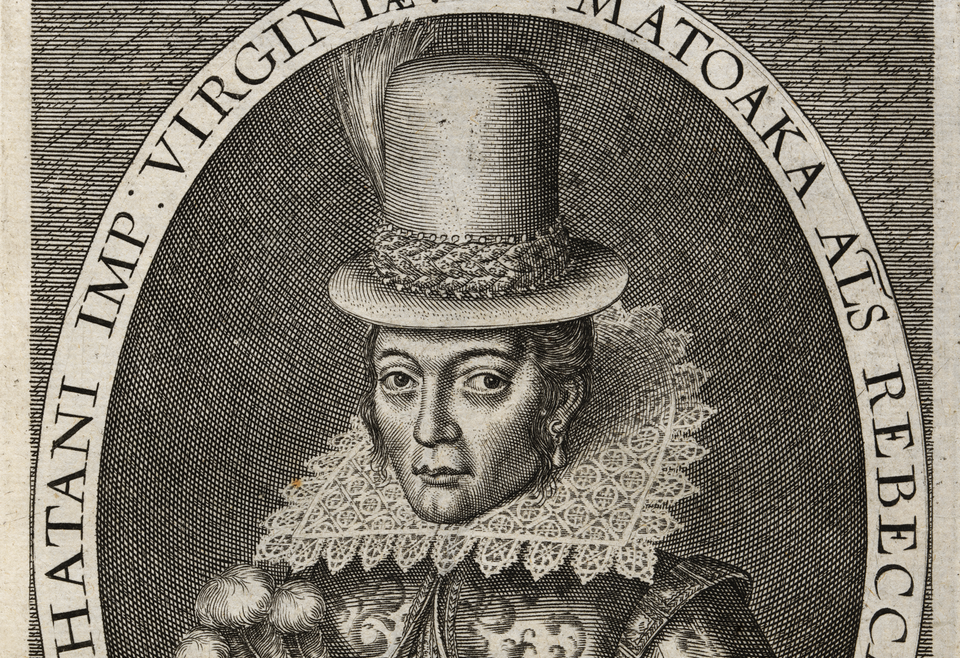
I love this portrait for a myriad of reasons. One, I am fascinated with this time period of colonial North America. Two, I love learning about cultural depictions of famed people, especially when they challenge or are different from the accepted cultural depiction (positively or negatively). Three, it is a striking portrait. Without a doubt, however, the portrait is an attempt by (presumably) an English artist to show the assimilation of an indigenous person into their own societies. But, it is a fact she lived in England and this is portrait attempts to help visualize what she may have looked like while living there. The featured image of this post is the original engraving this painting based on also tells its own story. From the link:
Pocahontas is dressed in English costume in rich shades of red, gold, and green, with white lace cuffs and high collar, a pearl earring, and holding a white and gold ostrich feather fan. To make Pocahontas’s English transformation complete, her skin, hair, and eye color have been significantly lightened.
One of my favorite tidbits of information about Pocahontas is the time-frame of when she was in England: 1616 - 1619. Within that time frame, living only a few hundred yards away and among the same social circles as her was Tisquantum (of the Patuxet tribe) – best known to history as "Squanto" – the man who helped the Pilgrims survive at their colony in Plymouth. Andrew Lipman's book on him is an awesome read.